The Lost History of 1914: Reconsidering the Year the Great War Began by Jack Beatty
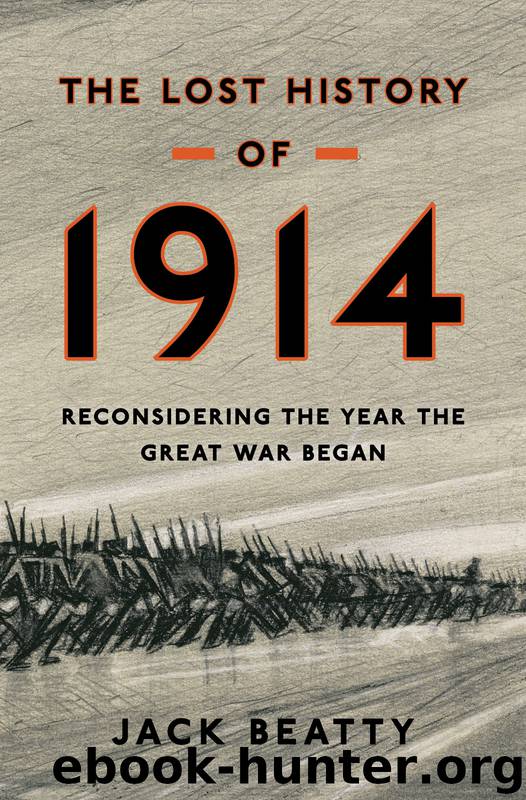
Author:Jack Beatty [Beatty, Jack]
Language: eng
Format: epub
Tags: General, History, Political Science, Europe, International Relations, World, Military, World War I, Mexico, Latin America
ISBN: 9780802778116
Publisher: Walker & Company
Published: 2012-02-14T00:00:00+00:00
Berthe Gueydan testifying at the trial of Henriette Caillaux. Their marriage foundered on your “vigor and power,” Joseph Caillaux told her in court. Men of the Third Republic needed soft women like Henriette (who was hard enough to take target practice before shooting Gaston Calmette).
They were married on October 31, 1911. Joseph was premier. Nineteen eleven would have been his triumphant year if imperialist rivalry had not brought France closer to war with Germany than at any other time since The Defeat of 1870, where the road to Morocco begins.22
In his memoirs, Charles de Gaulle evoked the desolate France of 1870–71, its army routed, Paris torn by fighting between Frenchmen, the king of Prussia crowned emperor of Germany at Versailles: “An immense disaster, a peace made of despair, loss of life that nothing compensated, a state without foundations, no army other than that which was leaving the enemy’s prisons, two provinces torn away, billions to be paid, the victor’s troops garrisoned in one-fourth of the territory, the capital streaming with blood in a civil war, a Europe ice cold or ironic: Such were the conditions in which a vanquished France resumed the march to its destiny.”23
Following Gambetta’s admonition, the French thought of revenge “always” but spoke of it “never.” In school classrooms a swag of black and purple cloth covered Alsace-Lorraine, the two provinces torn away by Bismarck, on the map of France. “You have no idea of the somber atmosphere in which we grew up, in a humiliated and wounded France—bred for bloody, inevitable and perhaps futile revenge,” the novelist Romain Rolland recalled. The young de Gaulle wrote a story set in 1930 in which, as “General Charles de Gaulle,” he liberated Lorraine.24
“Must we hypnotize ourselves with the lost provinces, and should we not take compensation elsewhere?” Premier Jules Ferry asked a leading revanchard. Beginning under Ferry in the 1880s, France embarked on a distinctly military form of imperialism, the “vile scramble for loot” that, between 1876 and 1915, saw six industrial powers carve colonies out of roughly one in every four acres of the earth’s surface. The inhabitants of those acres were pretty well carved up themselves. Writing in 1890 and of Africa only, a British observer estimated that “twenty millions of human beings underestimates the number killed or captured for European gain.”25
For France, a Republican politician declared, to fail to “carry wherever she can her language, her way of life, her flag, her arms … would be the high road to decadence.” Unable to extrude the enemy from Alsace-Lorraine without war, the French army conquered lesser breeds without artillery. In this way the French way of life was brought to Indochina, West Africa, Tunisia, and Morocco as earlier to Algeria. Ferry might lament: “All that interests the French public about the Empire is the belly dance.” Still, Frenchmen avidly followed newspaper accounts of colonial adventures, which furnished anecdotes against decadence. Conquest was therapy for the culture of defeat. For General Lyautey, the hero of the conquest of Morocco, colonialism was more than a cure.
Download
This site does not store any files on its server. We only index and link to content provided by other sites. Please contact the content providers to delete copyright contents if any and email us, we'll remove relevant links or contents immediately.
| Africa | Americas |
| Arctic & Antarctica | Asia |
| Australia & Oceania | Europe |
| Middle East | Russia |
| United States | World |
| Ancient Civilizations | Military |
| Historical Study & Educational Resources |
The Radium Girls by Kate Moore(12096)
100 Deadly Skills by Clint Emerson(4975)
Rise and Kill First by Ronen Bergman(4840)
The Templars by Dan Jones(4739)
The Doomsday Machine by Daniel Ellsberg(4557)
The Rape of Nanking by Iris Chang(4266)
Killing England by Bill O'Reilly(4043)
Stalin by Stephen Kotkin(4009)
Hitler in Los Angeles by Steven J. Ross(3981)
12 Strong by Doug Stanton(3582)
Hitler's Monsters by Eric Kurlander(3389)
The Code Book by Simon Singh(3252)
Blood and Sand by Alex Von Tunzelmann(3243)
Darkest Hour by Anthony McCarten(3163)
The Art of War Visualized by Jessica Hagy(3047)
Hitler's Flying Saucers: A Guide to German Flying Discs of the Second World War by Stevens Henry(2777)
Babylon's Ark by Lawrence Anthony(2722)
Tobruk by Peter Fitzsimons(2564)
The Second World Wars by Victor Davis Hanson(2554)
